Is Rice Good for Weight Loss? White, Brown, and the Math
Rice isn't the villain. The villain is the bowl size. The honest read on white, brown, jasmine, and basmati — with the cooling trick that has real research behind it.
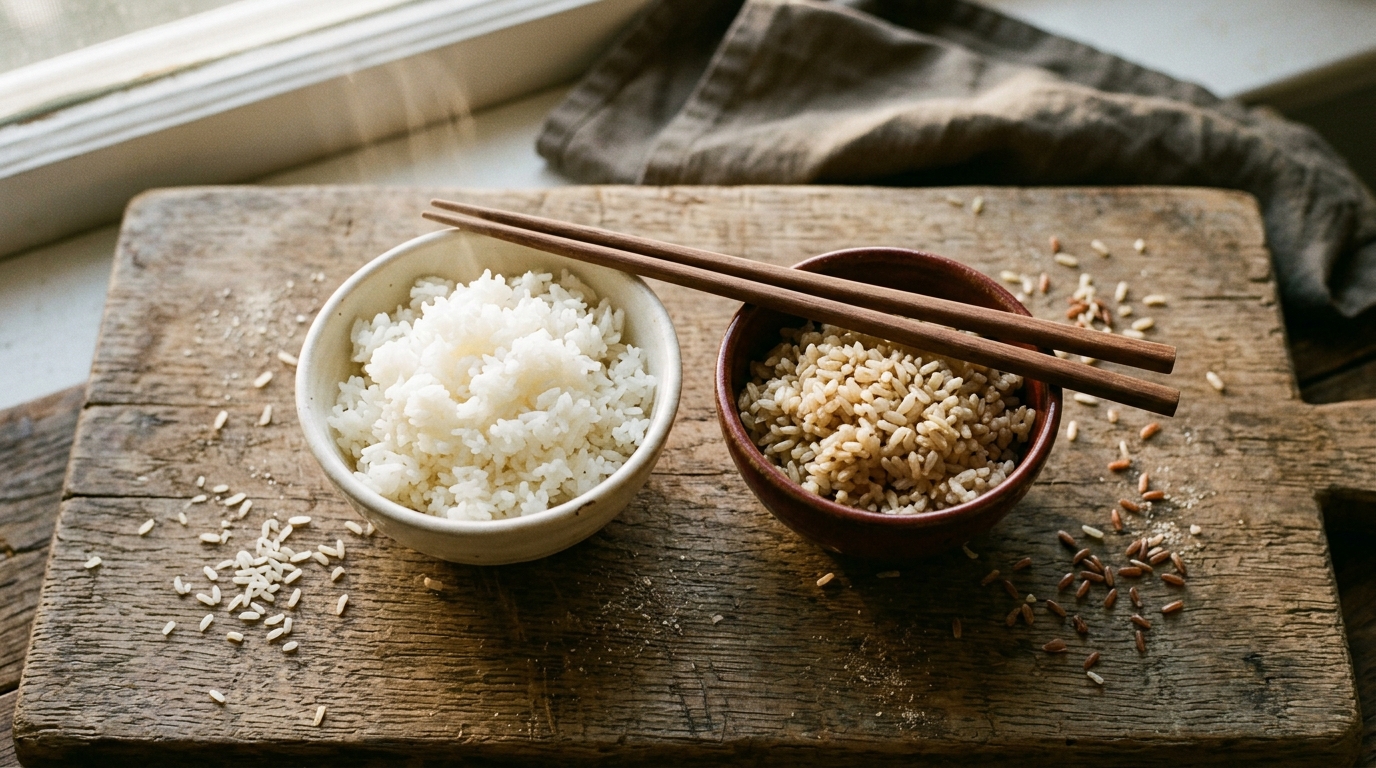
Yes — rice fits a weight-loss plan when you watch the portion. According to USDA FoodData Central, one cooked cup of white rice is about 205 calories, brown rice 215, with brown providing significantly more fiber. Harvard's nutrition guidance places rice in the same carbohydrate category as bread and pasta — useful at half-cup to one-cup servings, problematic at restaurant portion sizes (often 2 to 3 cups). The rice isn't the issue. The bowl is.
The calorie math you actually need
Per cup of cooked rice, from USDA FoodData Central:
- White rice (long grain): 205 kcal · 4 g protein · 45 g carb · 0.6 g fiber · 0 g fat
- Brown rice (long grain): 215 kcal · 5 g protein · 45 g carb · 3.5 g fiber · 1.7 g fat
- Jasmine rice: 205 kcal · 4 g protein · 45 g carb · 0.6 g fiber
- Basmati rice: 200 kcal · 4 g protein · 44 g carb · 0.7 g fiber
- Wild rice: 165 kcal · 7 g protein · 35 g carb · 3 g fiber
- Cauliflower rice: 25 kcal · 2 g protein · 5 g carb · 2 g fiber
Quick math. A normal Chinese takeout container is 3 cups of fried rice — that's 900 to 1,200 calories before you eat any of the entrée. The same takeout box with 1 cup of plain steamed rice is 200 calories. Same word, four-times difference.
White vs brown — the real differences
Three things matter:
- Fiber. Brown rice has 3.5 g per cup, white has 0.6 g. The fiber slows digestion and curbs hunger. Adult women target 25 g/day, adult men 38 g/day (Academy of Nutrition and Dietetics) — most Americans hit 15.
- Glycemic index. White rice GI ≈ 73, brown rice GI ≈ 68 — both moderately high. Basmati is lower (~58). Lower GI = steadier blood sugar = steadier appetite.
- Micronutrients. Brown rice has more magnesium, manganese, B vitamins, and selenium. White rice in the US is "enriched" — synthetic B-vitamins added back. Brown is the cleaner whole-food choice.
For pure weight loss, brown is a slight win. For digestibility, taste, and adherence, white is fine. Don't fight your taste buds — pick the version you'll actually portion-control.
Jasmine, basmati, sushi rice — the variety guide
- Basmati (white or brown): Lowest GI of the white rices. Pairs naturally with spiced or curry dishes. The pick if blood sugar matters.
- Jasmine: Higher GI, fragrant, sticky. Pairs with Thai and Vietnamese. Same calories — watch portion.
- Sushi rice (short grain): Very high GI. Cooked with sugar and rice vinegar (~30 extra calories per cup of rice). Restaurant sushi rolls average 350-500 calories per roll because of the rice volume.
- Wild rice: Technically a grass seed, not rice. Lower calories, more protein, more fiber. The best pick for weight loss if you like the flavor.
- Cauliflower rice: Not rice. But a useful 1:1 swap for half your rice serving — half cauliflower, half real rice. Cuts the calorie load nearly in half.
The portion that actually fits weight loss
The plate method, recommended by the USDA's MyPlate guidance:
- Half the plate: non-starchy vegetables (broccoli, peppers, leafy greens, etc.)
- Quarter of the plate: protein (chicken, fish, tofu, beans)
- Quarter of the plate: rice (or other carb) — about 1/2 cup cooked, sometimes up to 1 cup
A half-cup of cooked rice is 100 calories. A full cup is 200. A "Chipotle bowl" portion of rice is typically 1 to 1.5 cups. Eyeball it visually — it should look smaller than your protein and significantly smaller than the vegetables.
Practical tip: use a smaller bowl. Replacing an 8-inch dinner bowl with a 6-inch one cuts portion sizes by roughly 30 percent without conscious restriction (Wansink, JAMA 2013, replicated multiple times).
The rice-cooling trick (real research)
Cook rice. Cool it in the fridge for 12 to 24 hours. Reheat or eat cold.
What happens: when starch cools, it undergoes a process called retrogradation. Some of the starch crystallizes into resistant starch — a form your small intestine can't digest. It feeds gut bacteria instead, and yields about 2 calories per gram instead of 4. The Sonia et al. 2015 study in Asia Pacific Journal of Clinical Nutrition reported a 50 to 60 percent increase in resistant starch in cooled white rice vs. fresh.
The catch: the calorie reduction is modest — roughly 10 to 15 percent of the rice's calories, not 50. A 200-calorie cup of rice becomes a 170-calorie cup. Useful as part of a meal-prep workflow (Sunday-cooked rice eaten Monday-Friday) but not transformative on its own.
When rice is the wrong choice
- Restaurant fried rice. 800 to 1,200 calories per portion. Order steamed rice on the side instead.
- "Rice-based" cleanse diets. Mono-eating rice is nutrient-incomplete and unsustainable.
- Late-night rice bowls. Not because of timing magic, but because most people eat them in front of TV without portion awareness.
- If you have type 2 diabetes: high-GI white rice can spike blood sugar — talk to your doctor or dietitian about which rice and how much.
FAQ
Is rice good for weight loss?
Yes, in measured portions. Rice is roughly 200 calories per cooked cup — comparable to bread or pasta — and has zero fat. The Harvard School of Public Health notes that the issue with rice and weight gain is portion size, not the rice itself. Half-cup to one-cup servings fit any reasonable weight loss plan.
Which rice is best for weight loss — white or brown?
Brown rice has more fiber (3.5 g vs 0.6 g per cup), more micronutrients, and a lower glycemic index. White rice has slightly fewer calories and is easier to digest. For weight loss specifically, brown rice has a small edge because the fiber is more filling. For total satisfaction and adherence, eat the rice you actually enjoy.
How much rice should I eat for weight loss?
Half a cup to one cup of cooked rice per meal, paired with at least 4 oz of protein and a cup of vegetables. That's 100 to 200 calories of rice — leaving room for the rest of the meal. The plate method (1/4 plate carbs, 1/4 protein, 1/2 vegetables) from the USDA's MyPlate is a reliable guide.
Does cold rice actually help weight loss?
Partially yes. When cooked rice is cooled, some of its starch converts to resistant starch — a fiber-like substance that resists digestion in the small intestine. A 2015 study (Sonia et al., Asia Pacific Journal of Clinical Nutrition) found chilled rice had 60 percent more resistant starch than freshly cooked. The calorie impact is modest, not dramatic.
Is jasmine rice or basmati rice better for weight loss?
Basmati has a lower glycemic index than jasmine — it raises blood sugar more gradually, which supports steadier appetite. Both have nearly identical calories. If GI matters to you, choose basmati. If flavor matters more, eat what you enjoy in measured portions.
Read more on Real Easy Diet
- A 7-day Real Easy meal plan
- Healthy snacks for weight loss
- Smoothie recipes that actually keep you full
- How to lose water weight
- Does creatine help you lose weight?
- Does Pilates help you lose weight?
- Calorie deficit calculator
Sources
- USDA FoodData Central — Rice nutrient profiles
- Harvard School of Public Health — Rice and weight
- USDA MyPlate — Grains and portion guidance
- Sonia S et al. — Resistant starch in cooled rice, APJCN 2015
- Academy of Nutrition and Dietetics — Daily fiber
- American Diabetes Association — Whole grains and rice
A printable plan that refuses to count almonds.
Four-week schedule. Grocery list. Swap rules. No "fat-burning loophole." No app to download. You print it, you stick it on the fridge, you eat real food.
- 4-week schedule
- Grocery PDF
- Swap rules
- No app, no fees